
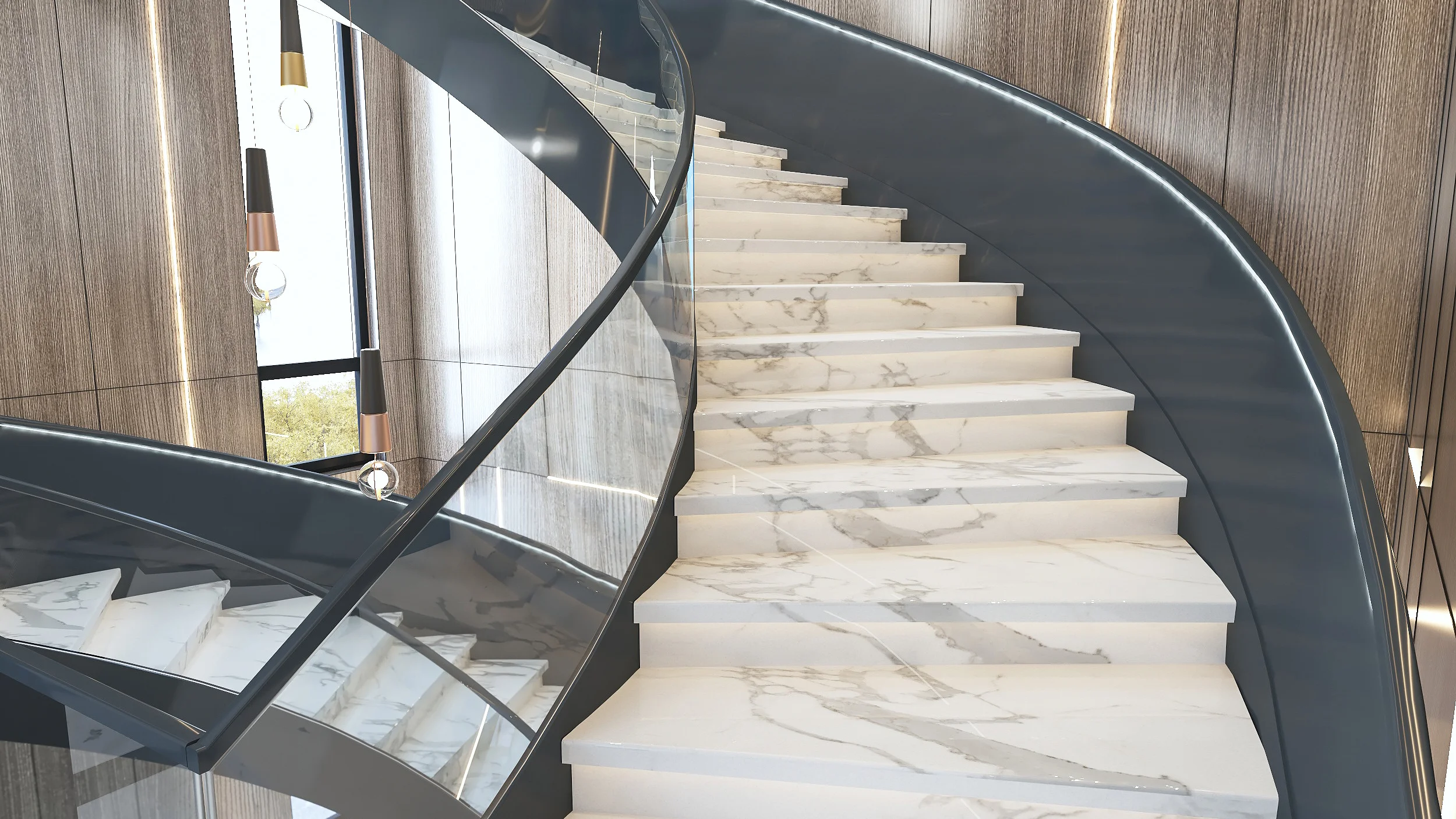
Marble Too Expensive? A Full Cost-Performance Analysis of Luxury Sintered Stone
Natural marble has been the ceiling of high-end residential and commercial projects for centuries. Its three real problems — price, maintenance, natural radioactivity — are pushing more procurement teams toward luxury sintered stone. We break down the full lifecycle cost, performance comparison, and supply reliability side by side.
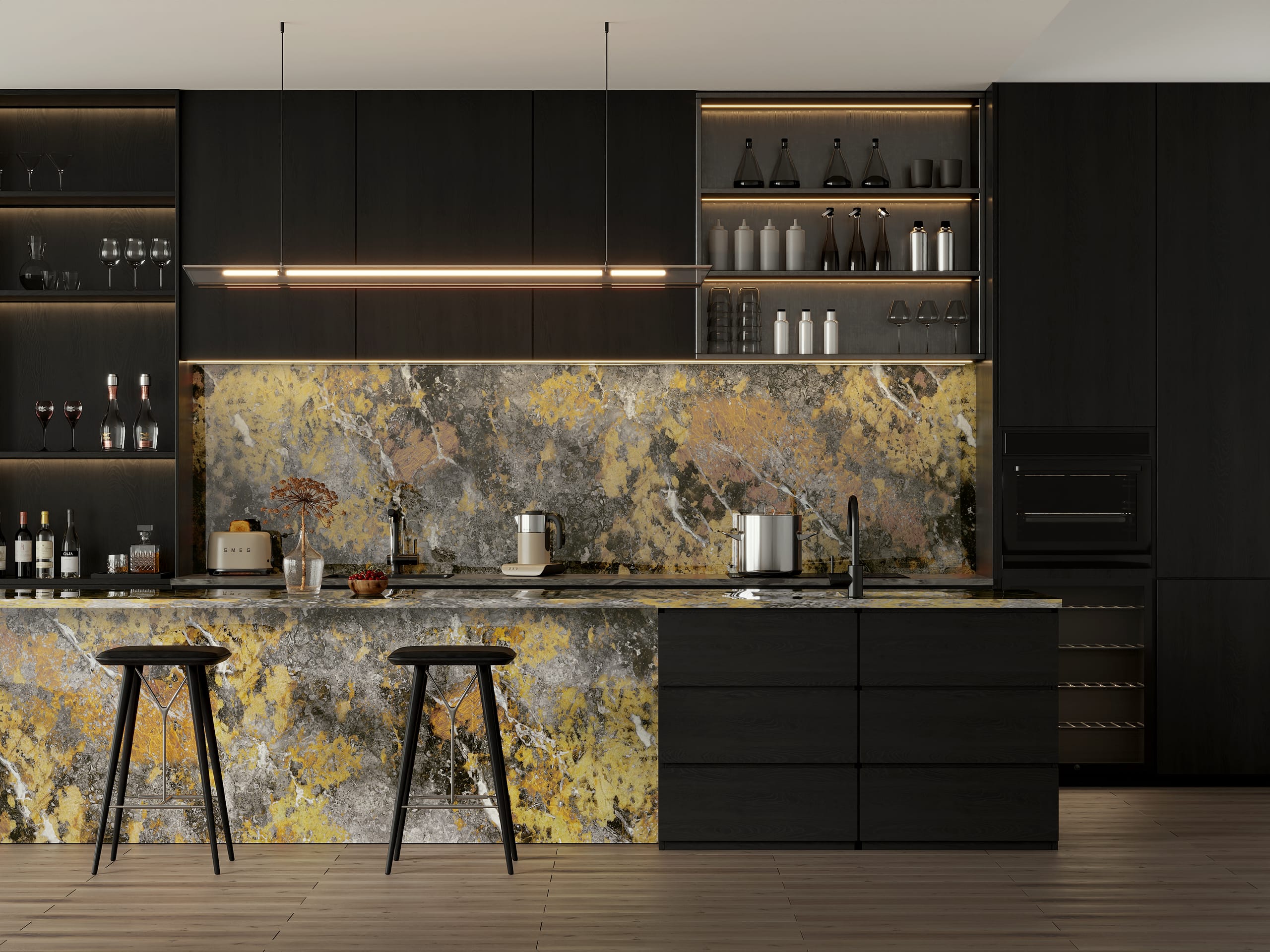
Owner reviews the design package: "The feature wall is spec'd in Calacatta marble. The quote is terrifying. Is there another way?"
It's the most common question we've heard for three years running. Premium natural marble has unmatched visual depth — but three structural problems push more and more projects to look for an alternative: price, maintenance, and natural radioactivity. Luxury sintered stone is the alternative the market has converged on. Here's the cost math.
Problem 1: Unit price
Approximate 2026 unit pricing for natural marble (delivered, before installation):
- Carrara White: $200–500/m²
- Statuario White: $550–1100/m²
- Calacatta Gold, Calacatta Grey: $900–2100/m²
- Bvlgari Grey, Onyx, Rosso Levanto: $1500–4500+/m² (block-cut, prices volatile)
Equivalent visual effect in luxury sintered stone:
- Mid-tier continuous-print sintered slab: $130–320/m²
- Premium through-body luxury sintered stone (Calacatta / Statuario / Bvlgari series): $250–650/m²
Mid-to-premium sintered slab runs roughly 15%–40% of the unit cost of the equivalent natural marble. On a 100m² feature wall project, that's an $80k to $20k swing in material cost. For many projects, this gap is the difference between "approved" and "value-engineered out."
Problem 2: Maintenance burden
Natural marble's structural weakness is porosity. The calcite crystal matrix has microscopic pores; porosity typically runs 0.3% to 1.5%, and water, oils, wine, coffee, and acidic foods all penetrate. A glass of red wine spilled on white marble overnight leaves a permanent purple-red stain.
High-end projects schedule resealing and polishing maintenance every 6–12 months: clean, hone, seal, dry, polish. Cost per visit on a 100m² lobby floor is $4,000–$11,000 per cycle. Over a 10-year service life, cumulative maintenance: $40,000–$110,000.
Sintered stone has ≤0.1% water absorption — effectively non-porous, zero maintenance. Daily cleaning is a neutral-pH wipe-down. Ten-year cumulative maintenance: essentially zero.
Problem 3: Natural radioactivity
Natural stone is a geological product and inevitably contains trace radioactive elements (uranium, thorium, potassium-40). The Chinese GB 6566 standard (Limits of Radionuclides in Building Materials) classifies materials into Class A (unrestricted use), Class B (exterior use only), and Class C (decorative exterior wall only).
Most marbles qualify as Class A, but certain dark granites and certain premium imported marbles fall into Class B or even Class C depending on source quarry. Indoor environments — homes, schools, hospitals — have low tolerance for radioactive exposure over sustained periods. Procuring premium natural stone requires reviewing radioactivity test reports per batch.
Sintered stone is engineered from controlled-composition mineral powders fired at 1200°C; radionuclide content is negligible across all tested samples, all classifying as Class A, and the consistency is batch-stable in a way natural stone is not.
Performance comparison
Side-by-side on the core specs:
- Stain resistance: marble stains easily; sintered stone zero absorption
- Heat tolerance: marble withstands 300°C; sintered stone withstands 800°C+
- Abrasion: marble Mohs 3–5; sintered stone Mohs 6–7
- Impact: marble brittle, chips at edges; sintered stone outperforms on impact strength
- Fire rating: marble A1; sintered stone A1 (equivalent)
- Max panel size: marble limited by block (typically ≤1200×2400mm); sintered stone 1600×3200mm standard, up to 1800×3600mm available
- Weight: marble 28–30 kg/m² (10mm); sintered stone 24 kg/m² (12mm)
- Colour variation: every marble slab differs; sintered stone same batch holds ΔE<1.5
Supply lead time and reliability
Natural marble supply is volatile. Premium patterns — Calacatta, Bvlgari Grey, Onyx — require block sourcing, sequential cutting, and finishing; 3–6 months from order to delivery is typical. Worse, batch-to-batch colour matching is impossible: a top-up order six months later will not match the original.
Sintered stone has stable supply timing. Standard patterns ship in 4–6 weeks; custom prints in 8–10 weeks. Same-batch colour matching holds within ΔE<1.5, so commercial projects can confidently re-order against the original spec.
5-year total cost comparison: 100m² luxury feature wall
Assume a 100m² lobby feature wall in Calacatta pattern:
- Natural Calacatta marble: material $85k + installation $8k + 5-yr maintenance $20k = $113k
- Premium through-body luxury sintered stone: material $32k + installation $6k + 5-yr maintenance ~$0 = $38k
Roughly $75k delta on a single wall. And in 90% of viewing conditions, the visual outcome is indistinguishable.
When natural marble still wins
Fair disclosure — luxury sintered stone is not a 100% replacement. Natural marble retains the edge in two scenarios:
Ultra-premium projects with extreme demands on vein depth and translucency. Real Calacatta and Onyx have an internal light-transmission quality at raking angles that sintered stone can't fully reproduce.
Heavily sculpted edge profiles. Natural marble fabricates easily into ogees, bullnoses, and curved decorative profiles. Sintered slab fabrication centres on mitre joints; complex curved edges are technically possible but expensive and craft-dependent.
Bottom line
If the brief reads "looks like marble, low-maintenance, easy to source, holds visual integrity at five years" — luxury sintered stone is the rational choice. If the brief reads "must be natural marble, willing to accept the full cost of ownership" — then specify the marble. These are not competitors in the same category; they're two delivery methods for the same visual ambition.
For real-world installation comparisons and luxury pattern photography, the product catalog sorts by colour series and the case gallery shows completed projects in Calacatta and Statuario sintered stone.